
The Thursday flood came without notice to some residents of Uyo, Akwa Statecapital. Although Nigeria Meteorological Agency, ( NiMet) had issued warning to flood states in the Federation. In the darkness of the night, frightened families scrambled to higher ground as muddy water rushed into their homes, swallowing furniture, food, electronics, school books and years of hard-earned possessions. Five days later, the floodwaters have receded from parts of Uyo, but the pain remains. Across Tabernacle Road, off Ikot Ekpene Road, and other flood-ravaged communities, residents are still counting their losses while waiting for the relief Governor Umo Eno promised on his return to the state through Victor Attah International Airport. For many, each passing day without assistance deepens the feeling that they have been left to face the disaster alone.
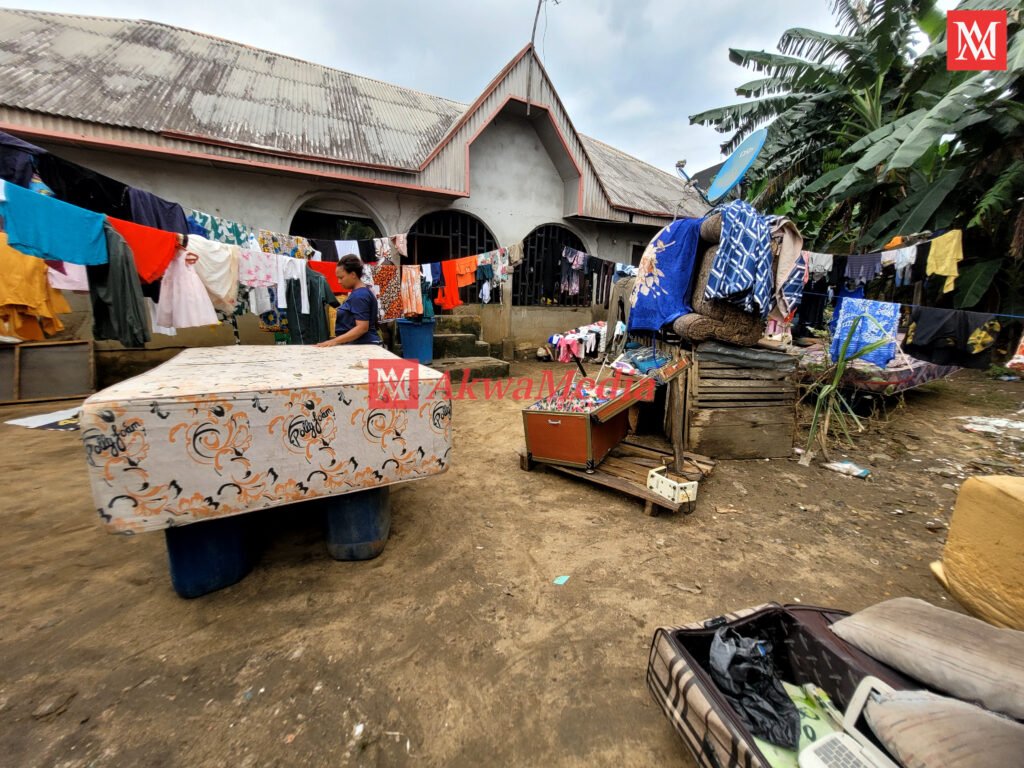
On Tabernacle Road, one of the communities worst hit by the July 9 flash flood, the struggle to recover is visible everywhere. Mattresses lean against walls in a desperate attempt to dry. Broken refrigerators, soaked wardrobes and damaged television sets litter compounds. Families spread clothes and books under the little sunshine available, hoping to salvage something before mould destroys everything. Children move quietly around homes stripped of comfort, while parents wonder how to rebuild lives that were washed away in a matter of hours. The residents have appealed to the Akwa Ibom State Emergency Management Agency (SEMA), the National Emergency Management Agency (NEMA) and the Ministry of Humanitarian Affairs for urgent intervention.
For a widow, Mrs. Blessing Christopher, the flood did more than destroy property; it threatened her family’s future. She earns a living selling ice cream, but the flood submerged her freezer, ruined cartons of ice cream, milk, rice and household food supplies, and destroyed her children’s school materials including textbooks. Supporting four children alone, including one preparing for the National Examinations Council (NECO) examination and another in the university, she now faces an uncertain future. “I only moved into this compound this year because I was told it doesn’t flood,” she says, standing beside the damaged freezer that once sustained her business.
Everything I depended on is gone. I don’t know where to begin again.
While her story echoes across the neighbourhood. Petty food trader, Nkechi Albert lost a full bag of garri and other provisions that represented months of investment. Another trader, Abasiama Edem, watched her stock of garri and crayfish disappear beneath the floodwater, while her children were forced to move in with relatives because all their clothes, except school uniforms, were destroyed. In one apartment, a university student carefully separates water-soaked certificates from damaged textbooks, hoping some documents can still be rescued. Every household carries its own version of loss, but together they paint the picture of a community struggling to survive.
Perhaps no account captures the violence of the flood better than that of a landlord Mr. Effiong Ekong who shares fence with the Tabernacle Church, (now abandoned) which the road is named after. Since building his home in 2006, he says floodwater had never entered the compound until recent years. After repairing a damaged perimeter fence following the 2024 flood, he believed the worst was over. This time, however, the flood water on the church side was up to 5 feet deep. He awoke to what he describes as “a wall of water falling into my compound like ocean waves.” Within minutes, his televisions, refrigerators, sofas, generators, tools for his refrigeration and air-conditioning business, and nearly 150 birds belonging to his wife had been destroyed. Today, his greatest concern is rebuilding the collapsed fence before insecurity compounds the disaster.
His tenant, Susan Attah, a University of Uyostaf, took us around her apartment, complaining she could not go to work the previous day as she was still scooping water out of her flat. Susan expressed bitterness with the damaged documents and files beside losing other valuables.
Across the Nkemba-Abak Road and Port Harcourt Street axis, similar scenes unfold. A school bag manufacturer, Mrs Esther Oddudu, stockfish trader, Edidiong and other ordinary households all recount losses ranging from collapsed perimeter fences to destroyed merchandise worth millions of naira. Yet residents insist that no government officials had visited many of the affected homes to document the damage in the immediate aftermath. For people whose livelihoods depended on small businesses, the absence of immediate assessment has become another source of anxiety. Sadly, the house of Iboko Ofot Village Head, Eteidung Udeme Etim Usanga was equally affected where power generators and some industrial sewing machines were damaged.
Government agencies acknowledge the scale of the disaster but say response efforts are still unfolding. The Head of NEMA’s Uyo Operations Office, Mrs. Aisueni Mmandu, confirmed that reports had been forwarded to the agency’s headquarters in Abuja and that decisions on intervention would come from Abuja. She also explained that NEMA would participate in any damage assessment coordinated by the Akwa Ibom State Government.
Meanwhile, the Commissioner for Information, Mr. Aniekan Umana, says SEMA is responsible for documenting victims and recommends that the immediate priority is reopening blocked drainage channels across the city. According to him, four construction companies- Amitec, U&K, Bulletin have already been mobilised to desilt drains, including major underground channels along Ikot Ekpene Road. Along Ikot Ekpene Road by Itikek street near Total Filling Station, Amitec workers were seen excavating to free up the underground drainage systems. Their project manager, Panama Michael said they were opening up to Itam Flyover. Nkemba-Abak Road drainage were equally opened but the responding to the urgency of Tabernacle Road, Mr. Aniekan Umana, Commissioner for Information reiterated that the state governor has given ultimatum to the construction company awarded to Road project to mobilise to site before July ending or the contract terminated.
“Tabernacle Road is under construction. The Governor gave the contractor a marching order to see significant progress to commiserate paymentsmade. The Commissioner for Works said work has been resumed there but for the rain. The Governor was not happy about the road situation.” Mr. Umana emphasized.
The flooding has also renewed questions about urban planning and infrastructure in Uyo. Residents argue that years of poorly executed road projects, blocked drainage systems, indiscriminate waste disposal and construction along natural waterways have combined to worsen flooding in communities like Tabernacle Road. Some homes now sit below road level, while others have effectively abandoned their ground floors during the rainy season because floodwater has become a recurring visitor. The state government says the contractor handling the Tabernacle Road project has been ordered to return to site or risk termination of the contract, but for residents trapped in the flood basin, the promise offers little comfort while rain clouds continue to gather overhead.
Beyond damaged buildings lies a quieter emergency—one measured in trauma rather than physical destruction. The fear of starting afresh intimates victims with the delusion of help in sight. However, health experts warned that losses during disaster could cause a mental health challenges. Bassey Akpan, Director of Public Health at the Akwa Ibom State Ministry of Health, confirmed that flood victims face significant mental health challenges arising from the loss of property, livelihoods and important personal documents. He also cautions against consuming contaminated borehole water, explaining that floodwater mixed with waste from damaged soakaways can pollute shallow aquifers and trigger outbreaks of cholera, rotavirus infections and hepatitis A. The public health implications, he says, may linger long after the floodwaters disappear.
The Uyo flood is therefore more than a story of heavy rainfall. It is a reminder that climate extremes are colliding with rapid urban expansion, inadequate drainage infrastructure and weak environmental management. Every flooded home tells the story of a family pushed further into poverty. Every damaged business represents another fragile livelihood interrupted. While emergency relief will help victims recover in the short term, lasting solutions lie in resilient urban planning, strict enforcement against building on floodplains, continuous drainage maintenance, effective waste management and stronger climate adaptation policies.
For now, however, these broader conversations offer little consolation to families still sleeping beside water-damaged belongings. Their immediate concern is simple: food, shelter, clean water and support to rebuild. As another rainy day approaches, residents of Tabernacle Road, Nung Ukot Itam and neighbouring communities continue to look down the road—not for another flood, but for the first signs that the help they were promised is finally on its way.
Dr. Akpan also warned that flooding leads to lack of clean water will affect personal hygiene and other uncomfortable situations. He further advised against indiscriminate waste disposal and building houses on flood lines instead citizens should consult Town Planning authorities. He suggested that both citizens and government agents should head to early warning systems such as Nigeria Meteorological Agency, (NiMet).

